AI Fantasy Football Trade Analyzer: Beyond Player Values
Contents
- What an AI fantasy football trade analyzer does (and where value-only grades stop)
- The four checks a trade grade should make: scoring settings, roster fit, depth, and schedule left
- Why a fair trade still fails: scouting the league-mate who has to accept it
- Trade analyzer vs. trade calculator vs. autonomous manager: what each one does
- Where Kleos Fantasy fits: drafting trades and scouting league-mates across every league
- A checklist for evaluating any AI trade analyzer before you send an offer
- Check the trade, then check who has to accept it
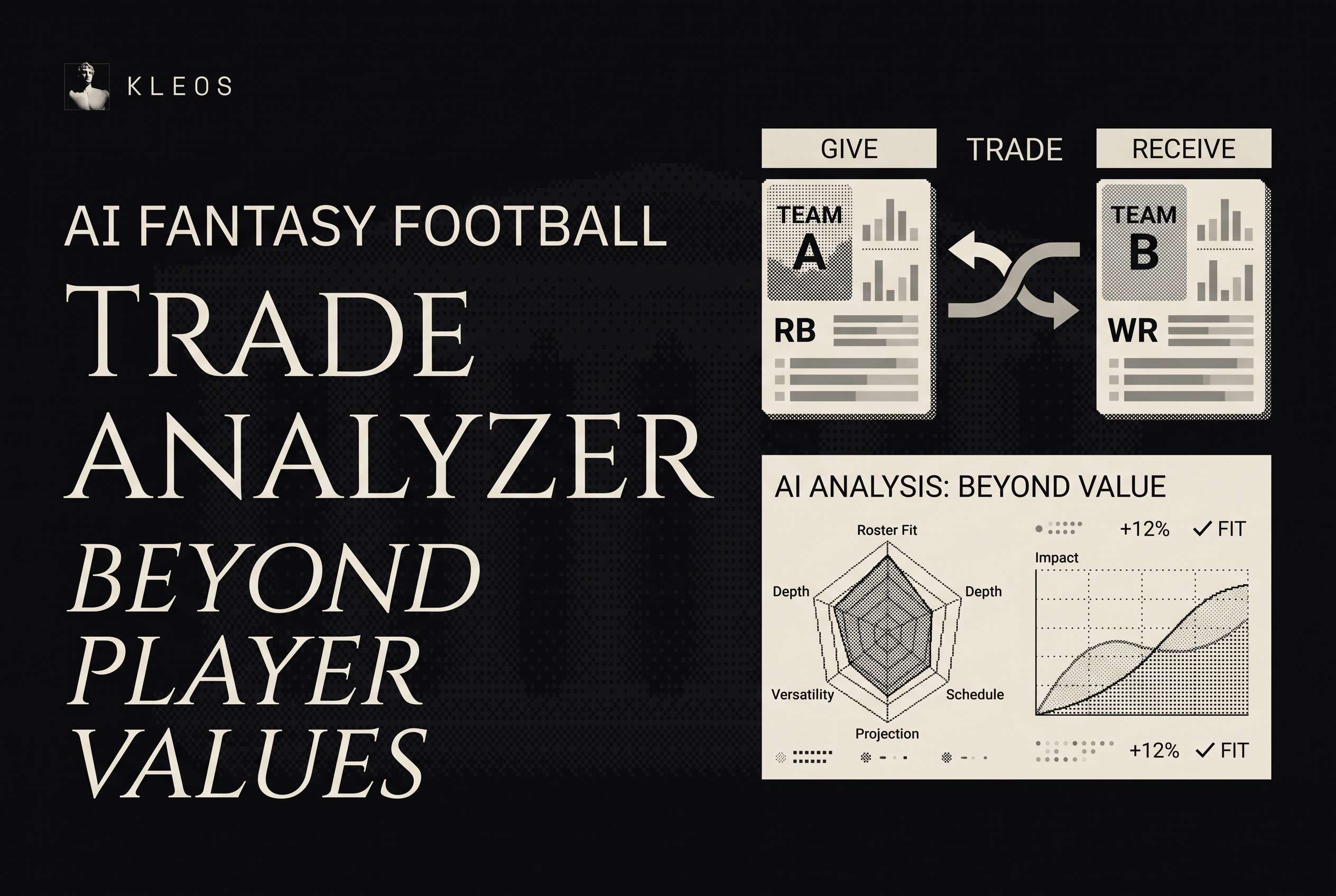
An AI fantasy football trade analyzer grades a proposed swap, and a good one checks far more than whether the player values add up. It weighs your scoring settings, your roster fit, your depth and whether the other manager will say yes.
Most tools stop at the first step. They compare two players, or two packages, and tell you which side "wins." That's a useful sanity check. It's also where the thinking should start, not finish.
This post walks through what an AI trade analyzer actually does, the four checks a real trade grade should make, why a fair trade still gets rejected, and how analyzers, calculators and autonomous managers differ. It ends with a checklist you can run on any tool before you send an offer.
What an AI fantasy football trade analyzer does (and where value-only grades stop)
An AI fantasy football trade analyzer takes a proposed trade, scores each side, and returns a verdict such as fair, favors you, or favors them. The better ones also adjust for uneven player counts, since a 2-for-1 changes what your bench looks like.
The scoring behind most verdicts is a value comparison. Each player gets a number, the numbers get summed, and the bigger total wins.
Value-only grades stop at the players. They don't know your league starts two flexes, that you already carry three running backs, or that your league-mate has been burned by every offer you've sent. A trade can be fair on a value chart and still be wrong for your team.
Treat a value grade as the floor. It tells you the swap isn't a robbery. It doesn't tell you the swap helps you.
The four checks a trade grade should make: scoring settings, roster fit, depth, and schedule left
A trade grade worth trusting runs four checks beyond raw value: your scoring settings, your roster fit, your depth, and the schedule left.
Scoring settings. Points per reception, tight end premiums, passing touchdown values and flex rules all move player worth. A receiver who is a luxury in standard scoring is a core piece in full PPR. If the analyzer never asks how your league scores, its grade is generic. Ask a tool how it handles your settings before you rely on it.
Roster fit. Value that sits on your bench is worth less than value that starts. Trading a surplus running back for a receiver upgrade at your WR2 slot helps. Trading for a third quarterback in a one-quarterback league doesn't, whatever the chart says.
Depth. Consolidation trades, where you give two players for one star, look great until a bye week and an injury arrive together. Check who fills the lineup spot you just opened, and whether your bench can absorb a bad week.
Schedule left. Mid-season trades are about the weeks that remain, not the weeks already played. A player with the playoffs against soft defenses is worth more to you in November than his season-long total suggests.
The same logic applies to start/sit calls, which we cover in our fantasy football lineup optimizer guide.
Why a fair trade still fails: scouting the league-mate who has to accept it
A fair trade still fails because the other manager has to say yes, and a value grade says nothing about what that person wants.
Every trade has two audiences. One is you. The other is a league-mate with their own roster holes, their own habits and their own opinion of what a good deal looks like. A manager stacked at running back and thin at receiver will ignore a running back-for-running back swap, however even it looks. A manager who never trades in-season won't answer a deadline-week offer at all.
That makes scouting the second half of trade analysis. Look at what the other roster is short on, what they've accepted or rejected before, and whether they're chasing a title or sitting out of the playoff picture. Then build the offer around their need, not just the numbers.
Here's a hypothetical. You offer a WR2 for a RB2 and the grade says "fair." The other manager has four running backs and one real receiver. The offer is fair on paper and dead on arrival. Re-aim it at a receiver-for-bench-depth swap that fills their gap, and the same value now has a reason to be accepted.
Some tools do try to estimate whether the other manager will accept, and that's a real step forward. It's still only one signal. Scouting a specific league-mate is the stronger one.
Trade analyzer vs. trade calculator vs. autonomous manager: what each one does
A trade calculator compares values, a trade analyzer adds context to the grade, and an autonomous manager scouts your league and drafts the offers for you. People blur these together, so here's how they differ.
| Trade calculator | AI trade analyzer | Autonomous manager | |
|---|---|---|---|
| Input | You enter both sides | You enter a proposed trade | Your connected leagues |
| Core output | Value total for each side | A verdict with some context | Drafted trade proposals |
| Considers your scoring and roster | Rarely | Sometimes | Part of the job |
| Considers the other manager | No | Occasionally | Scouts league-mates |
| Who finds the trade | You | You | The manager drafts it |
The key difference is who starts the work. With a calculator or analyzer, you already have a trade in mind and you're checking it. An autonomous manager works the other direction: it looks at your team and your league and proposes the trade for you to consider.
Neither approach is wrong. A calculator is fast for a gut check. The real variable is how many leagues you play. Checking one trade by hand is easy. Checking trade ideas across eight leagues before a deadline is not.
Where Kleos Fantasy fits: drafting trades and scouting league-mates across every league
Kleos Fantasy is an autonomous fantasy football manager that sets your lineup, works the waiver wire, scouts your league-mates and drafts the trades, in every league you play. It isn't a trade calculator where you type in two sides and read a grade.
That matters for the problem this post is about. The hard part of a trade is rarely the math. It's finding the offer the other manager will accept, and doing it in every league at once. Kleos scouts league-mates and drafts the trade proposals, so the work starts from your roster and your league rather than from a number you typed in.
It connects to Sleeper, ESPN and Yahoo leagues in about a minute and manages as many teams as you add. For the information behind its calls, it reads 45 reporters on X every 20 seconds, along with NFL injury reports, nflverse usage data, six projection sources and stadium weather.
It removes the weekly grind of scouting and drafting offers across a stack of leagues by hand.
A checklist for evaluating any AI trade analyzer before you send an offer
Run any AI trade analyzer through these questions before you trust its grade or send the offer.
Does it use your scoring settings? If it grades the same trade identically in standard and full PPR, it isn't reading your league.
Does it check roster fit? A good grade should change depending on whether the player starts for you or sits on your bench.
Does it account for depth? Ask what happens to your lineup if you give two players for one, especially during bye weeks.
Does it look at the schedule left? The weeks remaining should matter more than past production, particularly after midseason.
Does it handle your format? Redraft, keeper and dynasty value players differently, and so do picks. Confirm the tool covers yours.
Does it say anything about the other manager? Even a rough estimate of acceptance beats none.
Is the verdict stable? If the grade flips overnight, find out why. Injuries and news can move it, and a good tool tells you what changed.
Who finds the trade? If you have to come up with every idea yourself, you're using a checker, not a manager.
If a tool fails the first four, it's a calculator with an AI label. Use it for a quick sanity check and nothing more.
Check the trade, then check who has to accept it
A trade grade that only compares player values answers half the question. The other half is your scoring, your roster, your depth and the person on the other side of the offer. If you play in several leagues, scouting and drafting those offers by hand is the part that doesn't scale. Join the Kleos Fantasy waitlist at kleos.coach and let an autonomous manager scout your league-mates and draft the trades for you.
Sources
Frequently asked questions
Are AI fantasy football trade analyzers accurate?
They are accurate at what they measure, which is usually relative player value. They are less reliable on things they don't see: your scoring quirks, your bench, and whether the other manager will accept. Use a grade as a first filter, then check roster fit and scout the league-mate. Kleos Fantasy approaches it from the other side by scouting league-mates and drafting trades.
Do AI trade analyzers work for redraft and dynasty?
Some do. Certain tools offer separate redraft, keeper and dynasty modes, and some handle dynasty draft picks. Redraft cares about the current season and the weeks left, while dynasty weighs age and future value. Confirm a tool covers your format before trusting its grade.
Should you accept a trade an AI analyzer calls fair?
Not automatically. Fair means the values are close, not that the trade helps your team. Check that the incoming player starts for you, that your depth holds up through byes and injuries, and that the schedule left favors the move. A fair grade is a green light to keep checking, not to accept.
What is the best AI fantasy football trade analyzer?
It depends on the job. For a quick value check, a trade calculator or analyzer works. For finding and drafting offers across many leagues, an autonomous manager fits better. Kleos Fantasy scouts league-mates and drafts trades for every league you connect from Sleeper, ESPN and Yahoo, and it is currently waitlist-only.
Related reading
Written by
Kleos Fantasy